The Sunday Roast and the Shared Table: A Regional Meal Compared
See how a Sunday roast shared table can reveal local habits of serving, seating and hospitality, without mistaking one household’s custom for a regional rule.
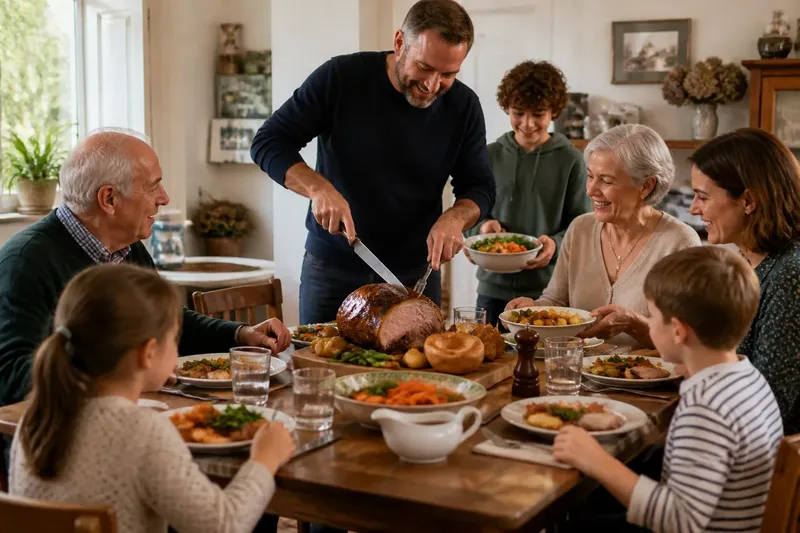
How can a Sunday roast shared table tell you something about a region without turning one family’s routine into a rule? Start with what you can observe: who serves, how food is passed and when people begin eating. The meal is familiar across Britain, but its social shape varies between households and localities.
These customs are not fixed. A family’s habits may reflect migration, work patterns, religious observance, household size or personal preference as much as local tradition. Notice how the food moves and who takes responsibility, then leave room for more than one explanation.
Serving as a signal
Serving customs organise the meal. In one home, the host may carve meat at the table and pass plates around. In another, food may arrive already portioned, or diners may help themselves from serving bowls. Neither arrangement is inherently more traditional; each gives people a different role.
Carving in front of guests makes the carver a visible host. Passing bowls asks diners to coordinate and make room for one another. A self-service arrangement can suit a larger gathering, letting people choose when to serve themselves. Such choices can express hospitality, but they need not be deliberate statements of regional identity.
The order of service also matters. Some households bring everything to the table together, while others serve in stages or hold back a dish until the main plates are ready. A pause may be practical: the meat needs carving, gravy needs pouring, or someone is still taking a seat. Read the sequence in its setting rather than assuming it signals a formal rule.
When you are a guest, wait for the host’s cue before helping yourself or beginning to eat.
Company shapes the meal
A roast can gather a household, welcome visitors or bring relatives together after time apart. The same dishes may support different kinds of company. A close family meal might have little ceremony, with conversation continuing as someone passes potatoes. A gathering with guests may include a more deliberate welcome or introductions before serving.
Seating can make relationships visible. People may choose familiar places, seat children near a parent or give older relatives an easier route to the table. At another gathering, hosts may mix guests so conversation crosses family or neighbourhood lines. Practical matters also shape the arrangement: mobility, room size and table shape all influence who sits where.
Say you are invited to a Sunday meal with several generations present. The host begins carving, asks a younger relative to carry the vegetables and leaves a grandparent seated comfortably. The observable result is a meal where tasks and comfort are shared among the people present; it does not establish a rule for the region.
Company can affect the pace, too. A meal with children may begin as soon as the food is ready, while a reunion might wait for a late guest. In some homes, conversation continues after plates are cleared; in others, people move to another room for tea. These are different ways of hosting, not rankings of warmth or hospitality.
Local patterns, not rules
Comparing regions means looking for patterns without turning them into stereotypes. In one place, a Sunday roast may be closely associated with gathering at home; elsewhere, a pub or community venue may be an equally familiar setting. Neighbouring communities can differ because of household routines, shared spaces or the people who have settled there.
The phrase “Sunday roast” can describe a meal eaten on Sunday or a broader kind of roast dinner served when family and friends can meet. For some, the day marks a pause in the week; for others, the meal happens when schedules allow. The shared occasion matters as much as the calendar.
For a grounded comparison, note details that you can actually see:
- Who serves: If one host portions the food, note that role; if several people help, record the shared work instead.
- Where food is portioned: If carving happens at the table, note the visible serving role; if food is plated in the kitchen, note that the arrangement keeps portioning out of view.
- How seating is chosen: If people take familiar places, note the established routine; if the host assigns seats, note that the gathering has a planned arrangement.
- When eating begins: If everyone waits until all are seated, note the shared cue; if people begin as plates arrive, note the more flexible pace.
- What happens afterwards: If the company stays together, note that the gathering continues at the table; if people move rooms or leave, note the change in the occasion.
- How help is offered: If guests are invited to carry dishes, note that tasks are shared; if the host declines help, let the host keep the serving routine.
These observations help distinguish a local pattern from an individual preference. A custom can be common without being universal, and a family may carry a practice from elsewhere while making it part of its present home.
When customs are misread?
Does everyone in a region serve the roast the same way?
No. Regional patterns describe tendencies, not rules followed by every household. Family history, guests, space and personal preference can all shape the meal.
Is carving at the table more traditional?
Not necessarily. Table carving makes serving visible, while kitchen plating may be easier for the host or better suited to the room. The meaning depends on the people and occasion.
What if a guest does not know when to start?
Wait for a cue from the host or follow the people around you. If the signal remains unclear, ask quietly rather than guessing.
Can a pub roast count as a shared-table custom?
It can, if the meal brings people together and has a social role for them. A public venue changes the setting, but it does not prevent diners from making the occasion communal.
Reading a gathering fairly
Food does not map neatly onto regional borders. A serving habit may be linked to a locality, but it may also come from one household’s routine or relatives who moved between places. When comparing neighbouring areas, record what you can see and allow for overlapping influences.
Describe actions rather than assigning motives. “The host carved and passed the plates” is more precise than “people there are formal”. “The family waited for everyone to sit” records an observed custom without claiming that every household shares it.
As a visitor, accept the invitation as it is offered. Take a seat where indicated, let the host establish the pace and offer help if it seems welcome. If you are hosting people from different backgrounds, explain where the food is, whether guests should serve themselves and when you plan to begin. Clear cues make room for everyone without presenting one household’s custom as a regional rule.
The Sunday roast shared table is best understood through small choices: who portions the food, how people are seated and whether the gathering continues after the meal. When comparing a roast in two places, note those choices and the people involved; that gives a more reliable account of the occasion than assuming that one serving style speaks for a whole region.